Quick Answer
Who repairs, replaces, and installs toilets on Long Island?
Sal Manzo Plumbing, Heating & Cooling provides residential and commercial toilet service across Nassau County and a tight nearby Long Island service grid. Call for running toilets, base leaks, weak flushes, recurring clogs, rocking bowls, broken tank parts, damaged flanges, replacement planning, new installation, comfort-height upgrades, water-efficient fixtures, flushometers, and urgent overflows. The first job is determining whether the problem belongs to the toilet, the water supply, the floor connection, the branch drain, or the main sewer line.
Long Island Toilet Service
The toilet is only one part of the plumbing problem
A toilet can fail inside the tank, leak at the supply connection, lose its seal at the floor, clog inside the trapway, rock because the flange or floor is damaged, or become the first fixture to reveal a larger drain or sewer problem. Reliable service starts by identifying which failure is actually present.
A constantly running toilet often involves the flapper, fill valve, flush valve, chain, handle, overflow tube, water level, or a seal that no longer closes correctly. Water at the base may come from a failed wax ring or other floor seal, but it can also come from tank bolts, the tank-to-bowl connection, condensation, a leaking supply line, a shutoff valve, a cracked tank, or a cracked bowl. A clog may be limited to the toilet, but repeated clogs, gurgling, sewer odors, or wastewater appearing in a tub or shower can point farther downstream.
Sal Manzo Plumbing, Heating & Cooling connects toilet service to the correct related path. A fixture leak may require leak detection and repair. A stubborn or recurring clog may belong with drain cleaning or sewer-line maintenance. An active overflow that will not stop belongs with emergency plumbing. That distinction protects the home and keeps a simple toilet repair from becoming a series of unrelated guesses.
Common Problems
Toilet symptoms that deserve a real diagnosis
The symptom tells us where to begin. It does not always identify the failed part. Testing the tank, bowl, seal, water connection, floor mounting, drain path, and nearby fixtures keeps a small repair from being confused with a larger plumbing failure.
Running toilet
A running toilet may waste water continuously even when the sound stops and starts. Common causes include a worn flapper, incorrect chain length, fill-valve failure, a damaged flush-valve seal, a water level set too high, debris, or a handle that prevents the valve from closing.
Water around the base
A base leak can damage finished flooring and the subfloor. The plumber checks the floor seal, closet bolts, flange, bowl, tank connections, supply, shutoff, and condensation before assuming the wax ring is the only possible cause.
Weak or incomplete flush
A weak flush may come from low tank water, a closing flapper, restricted rim jets, mineral buildup, a partial clog, an obstructed trapway, venting trouble, or a model whose performance no longer suits the bathroom.
Recurring clogs
A single clog may be local. Repeated clogs can involve the toilet trapway, objects, excessive paper, drain buildup, poor pitch, venting, roots, or a main-line restriction. The pattern matters more than another round with the plunger.
Rocking or loose toilet
Movement can break the floor seal and allow leakage. Causes include loose bolts, an uneven floor, missing shims, a damaged flange, deteriorated flooring, a poor previous installation, or a fixture that does not sit correctly.
Gurgling or sewer odor
Gurgling, changing bowl water levels, bubbles, odor, or wastewater in another fixture can indicate a drainage or venting problem. Stop repeated flushing and have the connected drain system evaluated before an overflow spreads.
Tank or bowl damage
Cracks, chips near mounting points, damaged porcelain, stripped bolt holes, warped components, and repeated tank-to-bowl leaks can make replacement safer and more practical than repeatedly rebuilding the same fixture.
Overflow or sewage backup
Shut off the toilet supply if it can be reached safely, stop using nearby fixtures, and call promptly. If wastewater is backing up through multiple fixtures, the problem may be in the branch drain, house trap, or sewer line rather than the toilet alone.
Repair Services
Repair the failed part without ignoring the system around it
Tank and flush repairs
Service may include the flapper, chain, trip lever, fill valve, flush valve, overflow tube, tank bolts, tank-to-bowl gasket, seals, water level, float, and related adjustments. The replacement part must fit the toilet and allow the tank to refill and shut off correctly. Universal packaging does not guarantee universal performance, because apparently even toilets have standards.
Supply and shutoff repairs
A leaking supply line, corroded shutoff valve, loose connection, damaged washer, or unreliable stop can spread water outside the fixture. The plumber may isolate the toilet, replace the failed connection, verify pressure and flow, and confirm the valve can be used later without threatening to break inside the wall.
Base seal and flange work
A leaking or rocking toilet may require removal, inspection of the closet flange, floor, bolts, seal, and drain opening, then proper resetting. A flange that is broken, too low, loose, corroded, or poorly repaired may need correction before a new seal and toilet can stay dependable.
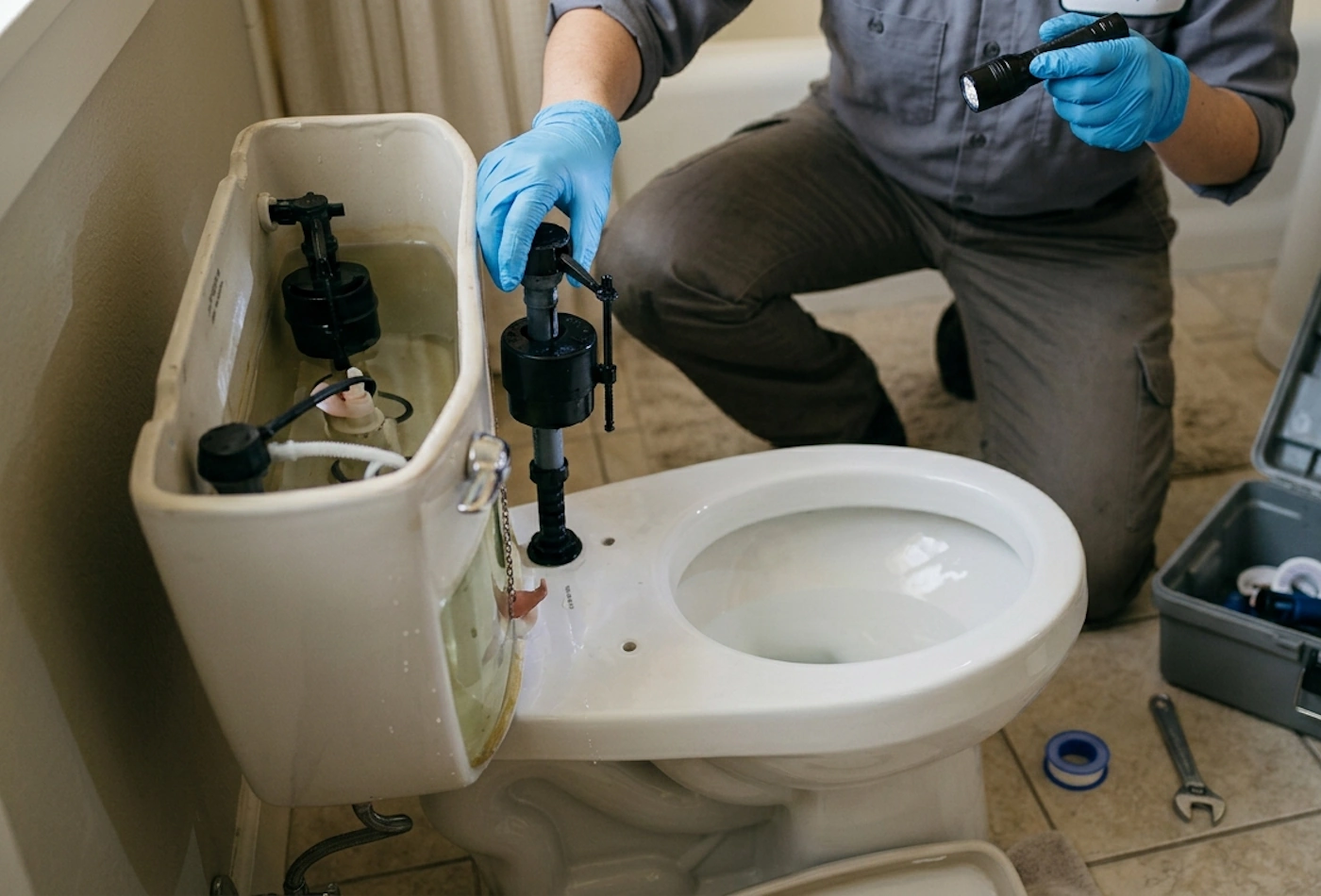
Repair is often sensible when the porcelain is sound, the toilet performs well, the rough-in and bathroom layout still work, replacement parts are available, and the failure is isolated. Replacement becomes more attractive when the fixture is cracked, chronically clogged, inefficient, unstable, difficult to service, incompatible with the household, or surrounded by deteriorated floor or flange conditions.
Repair or Replace
When a toilet repair is enough and when replacement makes more sense
Repair may be the better choice when
- The porcelain is sound and the bowl is stable
- The toilet generally flushes well and the problem is one failed part
- The flange and floor remain solid
- Replacement parts fit and are reasonably available
- The water use and bowl shape still meet the household’s needs
- The repair cost is proportionate to the fixture’s condition
Replacement deserves consideration when
- The tank or bowl is cracked, damaged, or repeatedly leaks
- Clogs continue despite a clear drain and proper use
- The fixture rocks because prior installation or floor conditions failed
- Parts are obsolete, proprietary, or repeatedly failing
- The household needs a different height, shape, flushing system, or accessibility feature
- A remodel, floor replacement, or plumbing change already requires removal
Replacement is not automatically the answer every time a flapper wears out. Repairing a dependable toilet can be practical and economical. On the other hand, repeatedly rebuilding an old fixture that clogs, leaks, wastes water, and no longer fits the bathroom is not thrift. It is a subscription plan nobody requested. Manzo explains the condition, installation requirements, and available options before approved work begins.
Replacement & Installation
A successful toilet installation begins before the new bowl reaches the bathroom
The new toilet has to fit the rough-in, floor space, plumbing connection, bathroom door and vanity clearances, user needs, drain location, shutoff condition, flange height, and intended use. Choosing from a photograph without checking those conditions is how a simple purchase becomes a return trip with a very heavy box.
Measure the rough-in
The rough-in is generally measured from the finished wall, not the baseboard, to the center of the closet bolts. Twelve inches is common, but 10-inch, 14-inch, offset, wall-hung, and unusual older installations exist. The actual bathroom decides what fits.
Inspect the flange and floor
The toilet depends on a secure, correctly positioned flange and a sound floor. Removal can reveal corrosion, broken mounting ears, prior spacer stacks, poor repairs, soft subfloor, damaged tile, or a flange set too high or too low for a reliable seal.
Confirm bowl shape and height
Round-front bowls may preserve space. Elongated bowls may improve comfort but need more room. Standard, chair-height, comfort-height, and accessible configurations affect sitting position, clearances, and who can use the bathroom comfortably.
Choose the flushing system
Gravity, dual-flush, pressure-assisted, flushometer, and smart-toilet systems have different water, pressure, maintenance, noise, electrical, and service considerations. The right choice depends on the property and expected use rather than whichever box has the most enthusiastic label.
Plan the water connection
The shutoff valve, supply line, inlet location, pressure, wall finish, and access should be checked. Smart toilets, integrated bidet seats, and some specialty fixtures may also need a properly located electrical receptacle and manufacturer-required clearances.
Install, secure, seal, and test
The old fixture is removed, the connection is prepared, the toilet is set without damaging the porcelain or flange, the supply is connected, the bowl is secured without overtightening, and repeated flushes verify filling, shutoff, drainage, stability, and leak-free operation.
Toilet Types
Residential toilets, specialty fixtures, and upgrades Manzo can help plan
One-piece toilets
The tank and bowl form one unit. They may offer easier exterior cleaning and a streamlined appearance, but they can be heavier to move and require careful measurement for the bathroom and delivery path.
Two-piece toilets
A separate tank and bowl make up the most familiar configuration. Many models offer broad parts availability and flexible choices in bowl shape, height, flushing design, water use, and price range.
Comfort-height and accessible
A taller seat may help some users sit and stand, but a higher fixture is not automatically ideal for every person. Commercial accessibility also depends on room layout, clear floor space, grab bars, centerline, and control location, not the toilet alone.
Wall-hung and tankless
These fixtures can simplify floor cleaning or suit certain commercial and modern bathrooms, but they may require wall carriers, in-wall components, flush valves, specific drainage, and more involved access for service.
Dual-flush and high-efficiency
Dual-flush and high-efficiency models are designed to reduce water use while maintaining performance. Selection should consider certified performance, household habits, drain conditions, parts support, and the actual flushing system.
Pressure-assisted toilets
Pressure-assisted units can provide a forceful flush and are common in demanding settings, but they have different internal components, sound levels, pressure requirements, and repair parts than ordinary gravity toilets.
Bidet seats and smart toilets
Heated seats, washing, drying, automatic flushing, deodorizing, lighting, and remote controls add comfort and complexity. Plumbing, electrical power, outlet protection, clearances, maintenance, and replacement-part support should be planned together.
Commercial flushometer fixtures
Tankless commercial bowls and flushometers are built for repeated use. Manual or sensor-operated valves, diaphragms, pistons, vacuum breakers, stops, handles, solenoids, and power sources may all affect the diagnosis.
Water Efficiency
Choose efficiency with verified performance, not wishful thinking
The U.S. Environmental Protection Agency’s WaterSense program identifies independently certified products that meet efficiency and performance criteria. A WaterSense-labeled toilet can help reduce water use compared with older fixtures, but the label does not eliminate the need to choose the right bowl shape, rough-in, height, flushing system, parts support, and installation method.
Water waste is not limited to old gallons-per-flush ratings. A modern toilet with a leaking flapper, incorrectly adjusted fill valve, damaged seal, or intermittent refill can still waste water. Repairing the leak may produce more immediate savings than replacing an otherwise suitable fixture. When replacement is appropriate, Manzo can help review water use and practical performance without promising that one model is perfect for every house.
Review EPA WaterSense product guidance and use the EPA’s product search to confirm current labeled models. Manufacturer specifications and local installation requirements should also be checked before purchase.
Real Work
A completed replacement installed cleanly and correctly
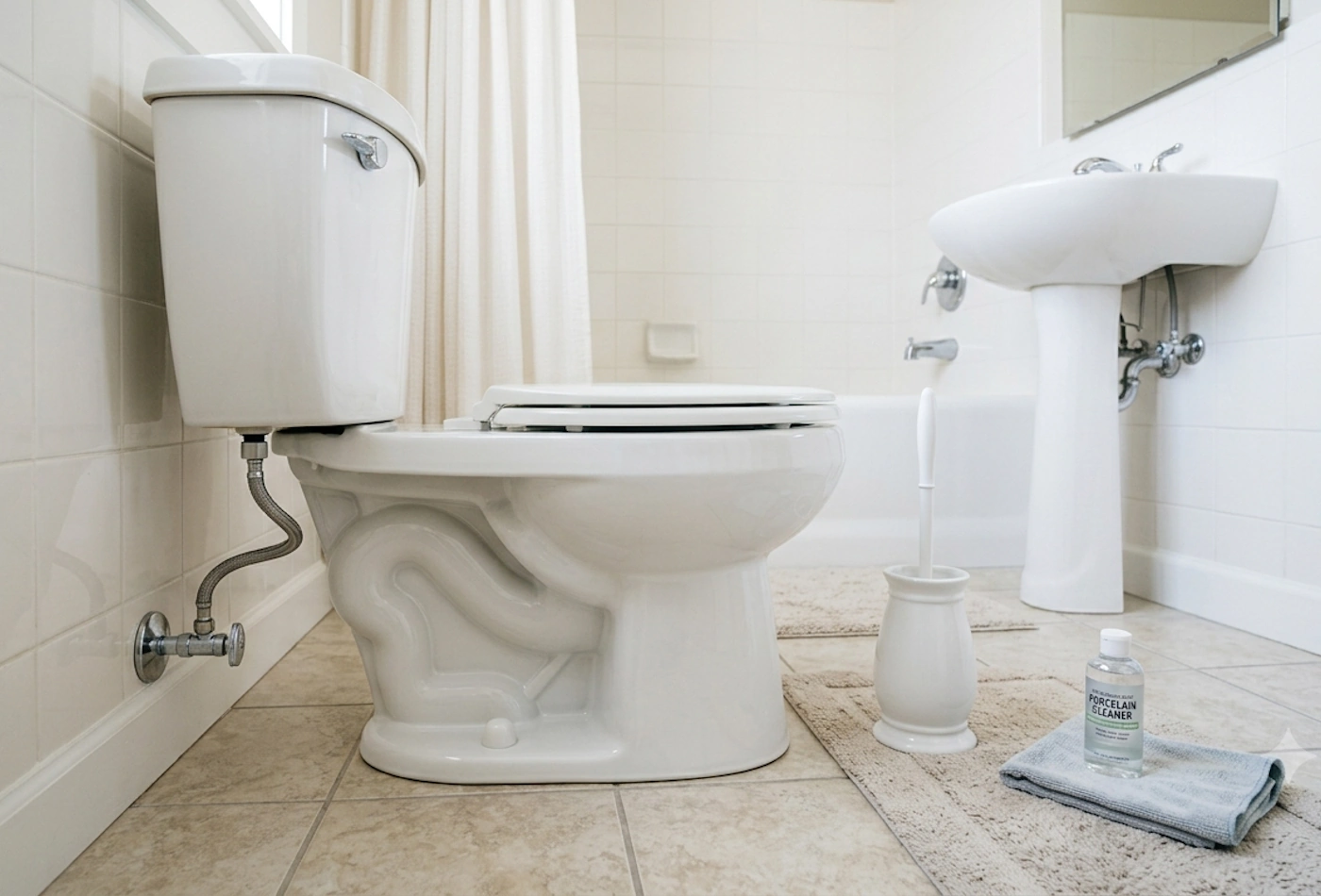
New installation after the fixture is secured, connected, tested, and the work area is clean. A useful composition may include the new toilet, accessible shutoff, finished floor, protected surrounding surfaces, and enough bathroom context to show the fit.
Commercial Toilet Service
Commercial restrooms need reliable fixtures, fast decisions, and minimal disruption
Restaurants, offices, retail stores, medical and professional spaces, multifamily properties, schools, houses of worship, managed buildings, and other commercial locations may depend on toilets and urinals that operate many times per day. A running flushometer, repeated clog, broken seat, loose bowl, sensor failure, shutoff problem, or inaccessible restroom can affect customers, employees, tenants, sanitation, and business operations.
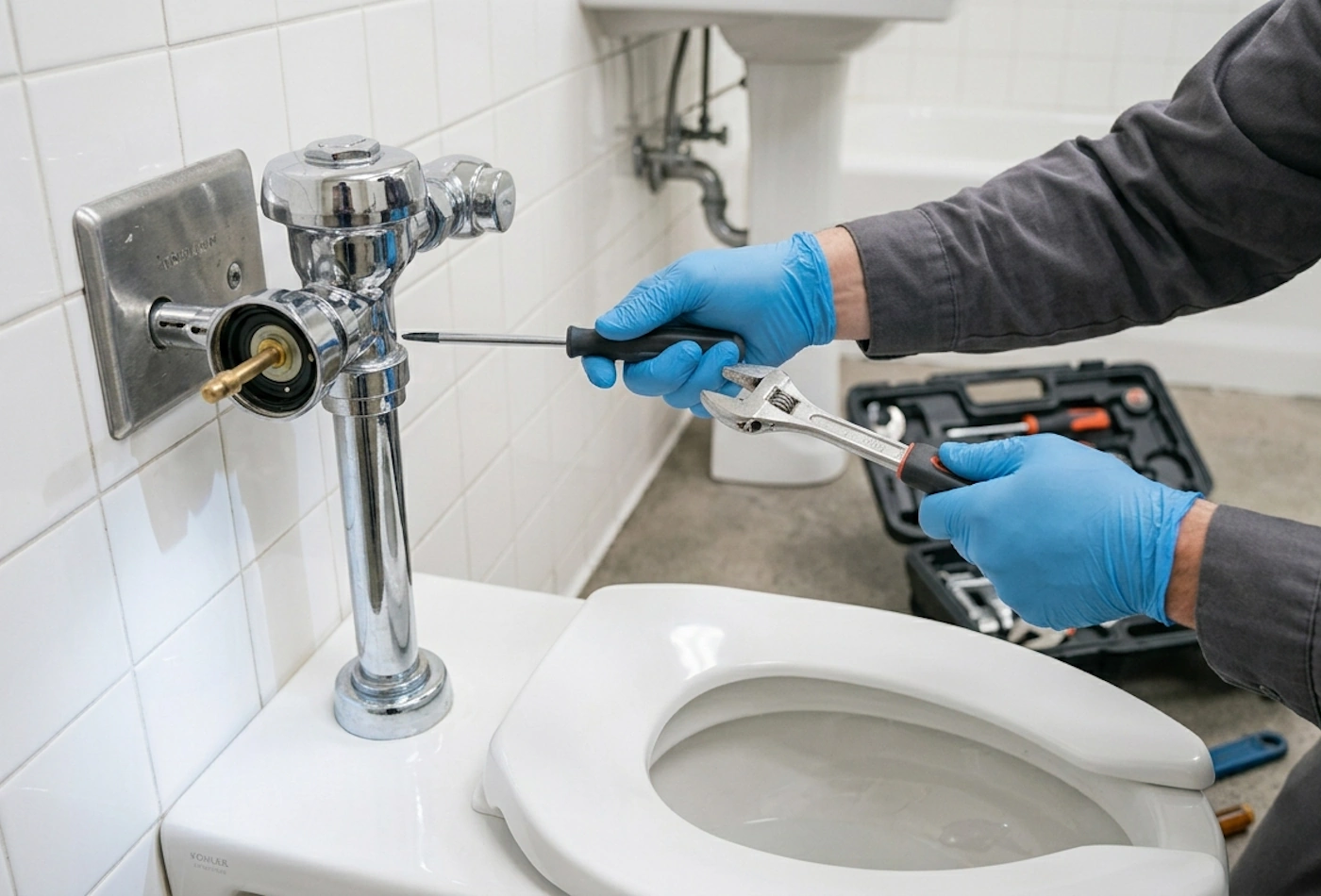
Flushometer repair
Manual and sensor-operated flush valves may involve diaphragms, pistons, handles, solenoids, sensors, batteries, power supplies, vacuum breakers, control stops, tailpieces, gaskets, flow settings, and water-pressure conditions. The valve and bowl must be matched and tested together.
Commercial toilet replacement
Floor-mounted, wall-hung, tank-type, flushometer, elongated, accessible, and specialty fixtures require correct rough-in, carrier or flange condition, supply sizing, valve compatibility, clearances, mounting, and coordination with building operations.
Restroom maintenance planning
Property managers can reduce emergencies by addressing slow flushes, recurring clogs, loose fixtures, leaking stops, failing sensors, corroded components, and unreliable shutoffs before the restroom is unavailable during occupied hours.
Accessibility work should be reviewed against the applicable project requirements and authority having jurisdiction. U.S. Access Board guidance covers fixture position, clearances, grab bars, and flush controls, including the location of manual controls on the open side in covered configurations. Manzo can perform plumbing work and coordinate fixture conditions, but a toilet replacement alone does not certify an entire restroom as compliant.
Real Work
Separate commercial expertise from ordinary residential repairs
Clog or Sewer Problem?
Know when the toilet is the problem and when it is reporting a larger blockage
A toilet that clogs once after too much paper or an object may have a local trapway obstruction. A toilet that clogs repeatedly can involve the fixture design, foreign material, buildup, a restricted branch drain, poor venting, damaged piping, roots, a house trap, or a main sewer problem. The location and timing of symptoms help narrow the cause.
If only one toilet is affected and nearby sinks, tubs, and other toilets drain normally, the obstruction may be local. If the toilet gurgles when a sink or washing machine drains, if water rises in a tub or shower, if multiple fixtures slow together, or if sewage returns through the lowest drain, stop using water and call. Continued flushing can turn diagnosis into cleanup.
Manzo can connect the call to Long Island drain cleaning, sewer-line maintenance, sewer-line repair or replacement planning, or house-trap service when the toilet is not the true endpoint of the problem.
Brands & Parts
Service for many common residential and commercial toilet brands
Manzo can evaluate many common toilets, internal tank components, seats, supplies, floor seals, mounting systems, bidet seats, pressure-assist units, flushometers, and commercial valves. Brand names help identify the equipment, but the model number, age, component design, and parts availability determine the practical repair.
Cost Factors
What changes the cost of toilet repair or installation on Long Island?
A reliable price depends on the actual toilet, failure, bathroom, access, parts, floor connection, and drain condition. Publishing one universal number would ignore whether the visit involves a flapper, a corroded shutoff, a broken flange, damaged flooring, a pressure-assisted system, a wall carrier, a smart toilet, or a commercial flushometer.
Repair scope
The failed component, diagnostic time, model-specific parts, access, corrosion, water pressure, shutoff condition, tank design, removal requirements, and whether the toilet must be reset all affect the repair.
Replacement scope
Fixture type, weight, rough-in, floor condition, flange height, old-toilet removal, supply and shutoff condition, seal, mounting, disposal, bidet or electrical requirements, and corrections revealed after removal affect installation.
Commercial scope
Flushometer parts, water pressure, wall carriers, sensor controls, shutoff access, occupied hours, restroom closure, tenant or customer impact, specialty fixtures, and coordination with a property manager can change the work plan.
Ask for diagnosis and a clear job-based scope. Then compare the repair with the condition and expected service life of the fixture. Review current Manzo offers and financing options for qualifying larger plumbing projects rather than embedding a temporary discount in a permanent authority page.
Tight Local Service Grid
Focused toilet service around Wantagh and nearby Nassau County communities
Toilet repair and basic replacement are often lower-ticket plumbing calls. The service strategy should therefore emphasize the practical five-to-ten-mile area around Manzo’s Wantagh location, where route efficiency supports faster scheduling and sensible service. The page can rank for Long Island and Nassau County while still being honest about the most valuable local grid.
Primary nearby coverage includes Wantagh, Seaford, Bellmore, Merrick, Massapequa, Massapequa Park, Levittown, East Meadow, Bethpage, Farmingdale, Hicksville, Plainview, and surrounding Nassau County neighborhoods. Nearby western Suffolk work may be scheduled based on the job, routing, and availability, particularly when toilet service is part of a larger plumbing project.
Service Process
From the first symptom to a stable, tested toilet
Describe the toilet and problem
Share the address, residential or commercial use, running, leak, clog, weak flush, movement, overflow, age if known, brand or model, and whether other drains are affected. Photos of the toilet, tank interior, supply, shutoff, and floor can help.
Diagnose the fixture and connected plumbing
The technician reviews the tank, bowl, supply, shutoff, floor mounting, flange, seal, drainage pattern, and nearby fixtures as appropriate. The goal is to separate a toilet repair from a branch-drain or sewer problem.
Complete approved work and test
After the scope is approved, the repair or installation is completed. The toilet is filled, flushed repeatedly, checked for shutoff, stability, leaks, drainage, and proper operation, then the work area is cleaned and the result explained.
Related Plumbing Paths
Faucets, sinks, and fixtures
A toilet call may uncover a leaking shutoff, vanity leak, damaged sink connection, or broader bathroom-fixture problem. Visit the new faucet, sink, and fixture repair hub.
Emergency plumbing
An uncontrollable overflow, sewage backup, active leak, or failed shutoff can damage the home quickly. Use emergency plumbing service when the problem cannot safely wait.
Drain and sewer service
Repeated clogs, gurgling, odor, or multiple affected fixtures may require drain cleaning, sewer maintenance, or further sewer evaluation.
Leak detection and piping
Water near the toilet may come from the fixture, shutoff, supply, wall, floor, or nearby piping. Review leak detection, piping and repiping, and water-line service when symptoms extend beyond one fixture.
Bathroom remodel plumbing
Moving a toilet, changing the rough-in, opening walls or floors, adding a bathroom, or coordinating new fixtures belongs with kitchen and bath rough-in plumbing.
Water treatment and fixture care
Mineral buildup, staining, valves, and household water concerns may connect to water treatment systems or water filtration. Treatment recommendations should match the actual water issue.
Why Call Manzo
Local Long Island plumbing experience with a clear service path
Sal Manzo Plumbing, Heating & Cooling has served Long Island since 1986 from Wantagh, providing plumbing, drain, water-heater, heating, and cooling service. The current live site shows more than 1,400 Google reviews and service across Nassau and nearby Suffolk communities. The toilet page uses that established company proof without inventing a toilet-specific review or pretending every repair requires a heroic origin story.
Toilet Service FAQs
Questions Long Island homeowners and property managers ask
Do you repair toilets across Nassau County and Long Island?
Yes. Sal Manzo Plumbing, Heating & Cooling provides toilet repair, replacement, and installation with a primary service grid around Wantagh and nearby Nassau County communities, including Seaford, Bellmore, Merrick, Massapequa, Levittown, East Meadow, Bethpage, Farmingdale, Hicksville, and Plainview. Nearby western Suffolk service depends on routing and job scope.
What causes a toilet to keep running?
Common causes include a worn flapper, damaged flush-valve seal, incorrect chain length, fill-valve failure, a water level set too high, debris, an overflow-tube problem, or a handle that prevents the valve from closing. Diagnosis confirms the failed component before parts are replaced.
Why is water leaking around the base of my toilet?
A failed floor seal is one possibility, but water can also come from the supply line, shutoff valve, tank bolts, tank-to-bowl gasket, condensation, a cracked tank, a cracked bowl, a damaged flange, or nearby piping. The source should be identified before resetting the fixture.
Should I repair or replace a toilet that clogs often?
Replacement may help when the fixture has a restricted or poorly performing trapway, damage, chronic performance problems, or an unsuitable design. Repeated clogs can also come from the branch drain, vent, house trap, roots, or sewer line, so the drainage pattern should be checked before blaming the toilet.
Can Manzo install a customer-supplied toilet?
Customer-supplied installation may be possible when the model fits the rough-in, bathroom space, flange, supply, shutoff, drainage, and intended use. Share the model number and specification sheet before the appointment. Missing parts, shipping damage, fit problems, or manufacturer defects may change the scope.
What measurements matter before buying a replacement toilet?
Measure the rough-in from the finished wall to the center of the closet bolts, plus available depth, width, door swing, vanity clearance, and space around the bowl. Confirm round or elongated shape, seat height, water connection, and whether electrical power is required for smart or bidet features.
Do you install comfort-height, chair-height, and ADA toilets?
Manzo can install taller and accessible-style fixtures when they fit the bathroom and project requirements. An accessible toilet room depends on more than fixture height, including centerline, clear floor space, grab bars, flush controls, and other conditions. A fixture replacement alone does not certify the whole room as ADA compliant.
Do WaterSense toilets flush well?
WaterSense-labeled toilets are independently certified to meet EPA efficiency and performance criteria. Performance still varies by model and application, so selection should consider rough-in, bowl shape, flushing system, household use, drain conditions, parts support, and manufacturer specifications.
Do you repair commercial toilets and flushometers?
Yes. Commercial service may include manual or sensor flushometers, diaphragms, pistons, handles, solenoids, batteries, vacuum breakers, control stops, wall-hung or floor-mounted bowls, leaks, recurring clogs, replacement planning, and restroom maintenance.
Is an overflowing toilet an emergency?
It can be. Shut off the toilet supply if it can be reached safely, stop flushing, and stop using nearby fixtures if sewage is backing up. Call promptly when water will not stop, wastewater appears in other fixtures, the shutoff fails, or water is spreading toward finished areas.
Why does my toilet gurgle when another drain is used?
Gurgling can indicate air movement caused by a partial blockage, venting issue, branch-drain restriction, house-trap problem, or main sewer condition. If multiple fixtures are affected, stop repeated flushing and have the connected drain system evaluated.
Can a loose or rocking toilet be repaired?
Often, but the toilet may need to be removed so the bolts, flange, seal, floor, and previous installation can be inspected. Tightening bolts without correcting an uneven floor or damaged flange can crack the porcelain or fail to stop movement.
How much does toilet repair or replacement cost?
Cost depends on the failure, parts, model, access, shutoff and supply condition, whether the toilet must be removed, flange and floor condition, customer-supplied versus plumber-supplied fixture, disposal, commercial controls, and any drain or sewer problem discovered during diagnosis.
What toilet brands can Manzo repair or install?
Manzo can evaluate many common brands, including TOTO, Kohler, American Standard, Gerber, Mansfield, Niagara, Duravit, Icera, Swiss Madison, Sloan, Zurn, Flushmate, Brondell, and others. Model-specific parts availability and fixture condition determine whether repair is practical.
Toilet Repair, Replacement & Installation
Stop the leak, clear the problem, or install the right replacement
Call Sal Manzo Plumbing, Heating & Cooling for residential and commercial toilet service across Nassau County and nearby Long Island communities. Describe the symptom, property, and whether other drains are affected so the team can route the call correctly.