Faucet, Sink & Fixture Repair on Long Island, NY
Repair, replacement, and installation for kitchen, bathroom, laundry, utility, outdoor, and commercial faucets, sinks, shutoffs, supply lines, drains, and connected fixtures across Nassau County and nearby Long Island communities.
Family-Owned Since 1986 Licensed Plumbing Service Repair • Replace • Install
Request Service
★★★★★ “Best plumber in Nassau County”
★★★★★ “Saved us during emergency”
★★★★★ “On time, clean work, fair price”
★★★★★ “Best plumber in Nassau County”
★★★★★ “Saved us during emergency”
Direct Answer
Who repairs, replaces, and installs faucets, sinks, and plumbing fixtures on Long Island?
Sal Manzo Plumbing, Heating & Cooling provides faucet, sink, and fixture repair, replacement, and installation across Nassau County and nearby western Suffolk communities. Service includes dripping faucets, leaking sinks, cartridges, valves, supply lines, drain connections, kitchen and bathroom fixtures, utility sinks, commercial fixtures, touchless controls, low pressure, water-quality concerns, and connected plumbing problems. Call (516) 783-0490.
Long Island Fixture Authority
One hub for faucet, sink, fixture, leak, drain, and installation decisions
A faucet and sink can look simple until the plumber opens the cabinet. The visible fixture is only the customer-facing end of a larger system that includes shutoff valves, supply tubing, water pressure, hot-water delivery, filtration connections, drain assemblies, traps, venting, countertop openings, mounting hardware, sealants, and sometimes a garbage disposal or appliance connection. A drip at the spout can be a cartridge problem. Water under the sink can come from the faucet body, supply line, shutoff, basket strainer, disposal flange, dishwasher connection, trap, drain, or a leak behind the wall.
This Long Island authority hub is deliberately broader than a routine faucet-repair. It supports homeowners replacing a kitchen faucet, landlords managing recurring sink leaks, restaurants dealing with a failed hand sink, offices upgrading public restroom fixtures, and families trying to understand whether low pressure is limited to one fixture or part of a larger plumbing condition. It also links directly into Manzo’s related leak detection, emergency plumbing, drain cleaning, garbage disposal, water line, and piping and repiping resources when the fixture is not the full problem.
The goal is not to make every minor drip sound like a disaster. It is to separate normal scheduled service from conditions that can damage cabinets, flooring, ceilings, walls, electrical components, or occupied commercial space. A faucet that drips into the basin is wasteful and annoying. A supply line spraying inside a vanity is urgent. A slow drain needs a different response than clean water leaking from a valve. Clear diagnosis keeps the customer from booking the wrong kind of repair, a rare triumph of organization over plumbing chaos.
Faucet, Sink & Fixture Services
Repair the visible problem and inspect the connections that make the fixture work
The service scope depends on what is leaking, clogged, loose, corroded, restricted, damaged, outdated, or being installed.
Dripping Faucet Repair
Persistent drips, worn cartridges, washers, ceramic discs, O-rings, valve seats, stems, loose handles, damaged spouts, and water that continues moving after the fixture is shut off.
Repair and diagnosis
Faucet Replacement
Replacement when the body is corroded, parts are unavailable, the finish is failing, the fixture is repeatedly leaking, or the customer wants a better layout, function, or finish.
Repair-versus-replace
New Faucet Installation
Kitchen, bathroom, bar, utility, laundry, wall-mounted, bridge, widespread, centerset, pull-down, pull-out, touch, touchless, and commercial faucet installation.
New installation
Sink Repair
Leaks at strainers, baskets, traps, supply lines, shutoffs, disposal flanges, drain connections, mounting clips, seals, caulk joints, and cracked or loose components.
Complete sink setup
Sink Replacement
Drop-in, undermount, farmhouse, pedestal, vessel, vanity, wall-hung, stainless steel, cast iron, composite, porcelain, utility, and commercial sink replacement.
Replacement planning
Commercial Fixtures
Public restrooms, offices, retail, restaurants, multifamily properties, medical and professional spaces, flush valves, metering faucets, sensor controls, and service sinks.
Business plumbing
Low Pressure & Flow
Clogged aerators, mineral buildup, partially closed valves, failed cartridges, restricted supply lines, pressure problems, corroded piping, and broader water-line conditions.
Flow troubleshooting
Hot-Water Problems
Slow hot-water delivery, uneven temperature, cross-connection symptoms, failing mixing components, water-heater limitations, recirculation issues, and fixture-specific temperature problems.
Hot-water crossover
Fixture Leak Detection
Cabinet moisture, hidden supply leaks, wall leaks, loose connections, drain leaks, intermittent drips, water stains, mold risk, and symptoms that require broader leak detection.
Damage prevention
Drain & Disposal Crossover
Slow sinks, recurring clogs, trap restrictions, disposal jams, disposal leaks, drain odors, grease buildup, and problems that belong on the drain or garbage-disposal service path.
Correct service path
Water Quality & Finish
Scale, staining, sediment, taste, odor, finish damage, clogged aerators, filtration questions, softening, and protecting new fixtures from water-quality conditions.
Water treatment
Accessible & Specialty
Lever controls, touchless operation, wall-hung fixtures, wheelchair clearance, metering controls, hand-washing stations, utility applications, and code-aware commercial planning.
Accessibility planning
When to Call
Small fixture symptoms can reveal larger supply, drain, or water-damage problems
Call for scheduled service when a fixture drips, handles become stiff, flow drops, the sink drains slowly, the sprayer loses pressure, the faucet base moves, or moisture appears under the cabinet. Call more urgently when water is spraying, spreading into finished materials, leaking near electricity, flowing through a ceiling, or cannot be stopped at a working shutoff valve.
Before the plumber arrives, safely close the fixture shutoffs when they operate normally. Do not force a corroded valve that feels ready to break. Clear the cabinet, remove stored cleaners and paper products, and note whether the leak happens continuously, only while the faucet runs, only while the sink drains, or only when a disposal or dishwasher operates. That timing is valuable diagnostic evidence.
When the problem is active and damaging the property, use Manzo’s emergency plumber page. When the moisture source is hidden, recurring, or not clearly connected to the visible fixture, the better next step may be professional leak detection and repair.
Faucet Repair
Drips, cartridges, handles, sprayers, sensors, pressure, and temperature
A faucet that leaks from the spout usually has an internal sealing problem, but the correct part depends on the design. Compression faucets may rely on washers and valve seats. Cartridge faucets use replaceable cartridges and seals. Ceramic-disc fixtures use paired discs and specialized components. Ball-style faucets contain a different collection of springs, seats, cams, and O-rings. Identifying the manufacturer and model can make the repair faster, but the technician still needs to inspect the fixture body, finish, mounting, supply connections, and shutoffs before deciding that one internal part will restore reliable service.
Leaks around the handle or base can behave differently from a spout drip. Water may escape only while the faucet is running, travel through the faucet body, and appear below the counter several minutes later. A pull-down or pull-out faucet adds a hose, weight, docking mechanism, sprayer head, diverter, and connection points beneath the sink. Touch and touchless models can add batteries, power supplies, solenoids, sensors, control boxes, and proprietary wiring. Those parts create convenience when they work and an impressive amount of confusion when they do not.
Low flow at one faucet often begins with a clogged aerator, mineral buildup, debris after nearby plumbing work, a partially closed shutoff, a damaged supply line, or a failing cartridge. Low flow at several fixtures may point toward pressure, water-line, filtration, softener, valve, or piping conditions. A technician should compare hot and cold flow, inspect the aerator and supply path, and determine whether the problem stays at the fixture or continues upstream. Manzo’s water line service and repiping guidance cover problems that affect more than one
faucet.
Temperature complaints deserve the same discipline. A faucet that will not produce hot water may have a cartridge or mixing problem, but it may also expose a water-heater, recirculation, cross-connection, tempering, or hot-water distribution issue. If hot-water performance is poor throughout the property, review the main water heater services page rather than replacing a perfectly innocent faucet because it happened to be where the complaint was noticed.
Replacement & Installation
Compatibility, rough-ins, hole patterns, accessories, and project planning
Successful faucet installation starts before the box is opened. The new fixture must match the sink or countertop hole pattern, hole diameter, deck thickness, mounting clearance, backsplash clearance, handle movement, spout reach, bowl size, and the location of existing valves and supply lines. A single-hole faucet can sometimes be installed in a three-hole sink with a deck plate. A widespread bathroom faucet needs separate hot, cold, and spout openings. A wall-mounted faucet may require rough-in dimensions and piping inside the wall to align precisely with the finished surface. Product photos do not show these conflicts because product photos have never had to work inside a crowded Long Island sink cabinet.
Kitchen installations may include pull-down sprayers, side sprayers, soap dispensers, filtered-water faucets, instant-hot dispensers, air gaps, dishwasher connections, disposal switches, and reverse-osmosis lines. Each accessory uses space above and below the counter. A deep sink or large disposal can interfere with the pull-down hose and weight. A farmhouse sink can change cabinet geometry. Countertop fabricators may need exact templates. When the project changes the sink, countertop, cabinets, or drain location, the work belongs in a coordinated installation plan rather than a last-minute faucet swap.
Bathroom projects have their own constraints. Vanity tops may use centerset, widespread, vessel, or single-hole faucets. Vessel sinks often require taller faucets or wall-mounted spouts with carefully planned reach. Pedestal and wall-hung sinks leave more plumbing visible, so the supply and drain layout affects the finished appearance. Accessible fixtures can require clearances, knee space, protected piping, and controls that are easier to operate. The supplied manufacturer instructions, local code requirements, and the actual field conditions govern the installation.
Customer-supplied fixtures can be installed when they fit the application and include the required components, but the customer should keep model information, receipts, warranty documents, and all packaging until the installation is tested. Missing proprietary adapters, damaged finishes, incompatible drain assemblies, or fixtures purchased for the wrong hole pattern can delay the job. Plumber-supplied options may simplify compatibility and warranty coordination. The right path depends on the project, not on a blanket rule designed to sell the most expensive box.
Sink Repair
Supply leaks, drain leaks, loose mounting, cracks, clogs, and cabinet damage
A sink leak is not one diagnosis. Clean water can leak from the hot or cold supply line, shutoff valve, faucet body, sprayer hose, soap dispenser, filtration connection, or instant-hot component. Drain water can leak from the basket strainer, pop-up assembly, tailpiece, disposal flange, P-trap, slip joint, dishwasher hose, or a cracked fitting. Water can also travel along the underside of the sink and drip far from the actual source. The plumber should run the faucet, fill the basin, release the drain, operate the sprayer and disposal, and inspect each connection under realistic use.
Loose or separated sinks create a different risk. Undermount sinks rely on clips, adhesives, rails, or support systems that can fail under the weight of the basin, water, cookware, and a disposal. Drop-in sinks can leak around a deteriorated rim seal. Farmhouse sinks need cabinet support because the front apron changes how the load is carried. Pedestal and wall-hung sinks depend on secure mounting and properly aligned plumbing. A sink that moves should not be treated as a caulking problem until the support system is inspected.
Cracks and finish damage also need context. A small chip in porcelain may be cosmetic, while a crack through the basin can leak or worsen. Corrosion in an older steel or cast-iron sink may make spot repair temporary. Composite, fireclay, stainless, copper, vitreous china, and solid-surface fixtures respond differently to impact, heat, cleaners, and mounting stress. The replacement decision should consider condition, availability, countertop impact, cabinet work, plumbing changes, and the customer’s plans for the room.
Slow drainage belongs in the sink evaluation but may require dedicated drain cleaning. Hair, soap, grease, food residue, scale, foreign objects, trap restrictions, poor venting, or a deeper line problem can produce similar symptoms. A recurring clog should not be disguised by repeated chemical treatment. Harsh cleaners can damage finishes, seals, piping, and the technician who later opens the line. Humanity invented proper drain tools for a reason.
Fixture Types
Kitchen, bathroom, laundry, utility, outdoor, and specialty sinks
The fixture category affects the installation method, mounting, drain, supply, support, accessibility, and coordination with counters or cabinets. The list below is representative, not a promise that every unusual imported fixture can be repaired with a part found on the truck. Model information and clear photos help the office prepare for specialty work.
Kitchen sinks
Drop-in, undermount, farmhouse, workstation, integrated, stainless steel, cast iron, fireclay, composite, granite-composite, copper, single-bowl, double-bowl, bar, and prep sinks.
Bathroom sinks
Vanity-top, undermount, drop-in, pedestal, vessel, console, wall-hung, integrated, vitreous china, porcelain, glass, stone, and accessible lavatories.
Laundry and utility sinks
Freestanding tubs, cabinet-mounted utility sinks, wall-mounted service sinks, laundry faucets, hose connections, washing-machine crossover, and basement applications.
Commercial sinks
Hand sinks, prep sinks, bar sinks, mop or service sinks, public lavatories, wall-hung fixtures, sensor faucets, metering controls, splash and sanitation considerations.
Outdoor fixtures
Hose bibbs, sillcocks, yard or utility faucets, freeze-resistant designs, vacuum breakers, outdoor sinks, seasonal shutoffs, and winter damage prevention.
Specialty fixtures
Filtered-water faucets, reverse-osmosis faucets, instant-hot dispensers, pot fillers, beverage faucets, touchless controls, soap dispensers, and appliance connections.
Kitchen faucet and sink repair customers can recognize immediately
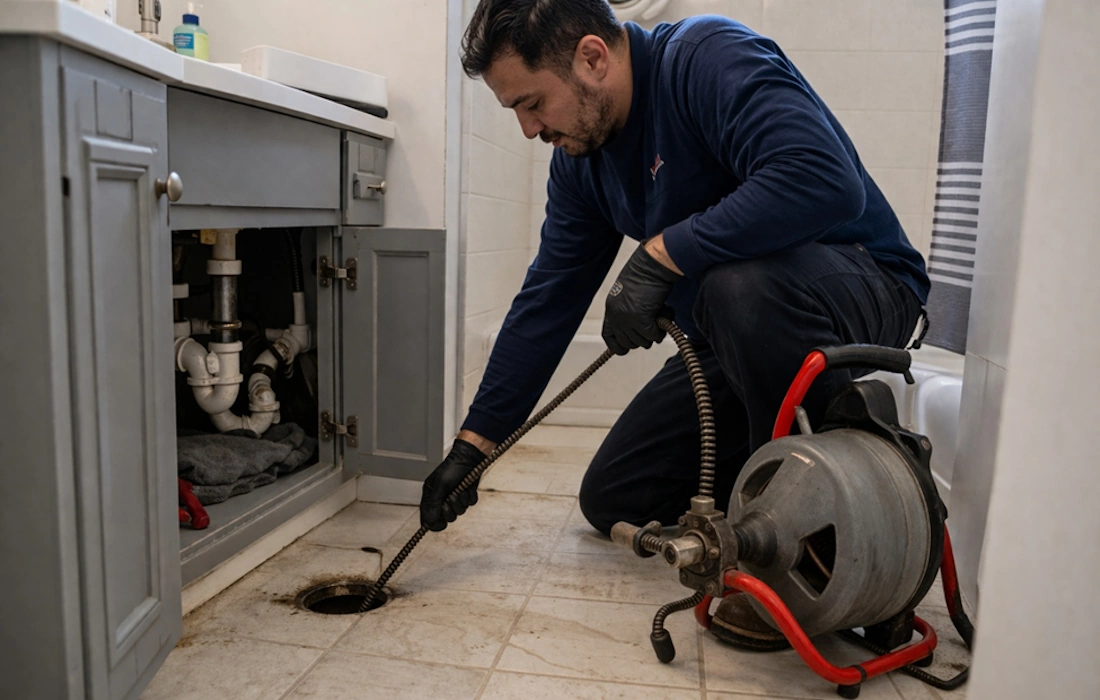
Kitchen Fixture Authority
Kitchen faucets, sinks, sprayers, disposals, filtration, and appliance connections
The kitchen sink is a small mechanical room disguised as cabinetry. A typical setup may include hot and cold shutoffs, braided supplies, a faucet, pull-down hose, soap dispenser, basket strainer, disposal, dishwasher discharge, air gap, filtration faucet, reverse-osmosis tank, instant-hot unit, trap, cleanout, and several electrical components. One leak can travel across the cabinet floor and damage particleboard, finished panels, flooring, or the ceiling below before the homeowner identifies which component failed.
Kitchen faucet repair should account for how the fixture is used. Pull-down hoses flex thousands of times. Spray heads accumulate scale. Docking systems loosen. Diverters clog. Touchless controls depend on sensors and power. Commercial-style spring faucets create higher mechanical loads at the mounting point. Pot fillers require reliable shutoffs and careful wall connections because a leak above a range is a particularly theatrical way for a kitchen to demand attention.
Sink replacement can affect more than the basin. A deeper sink changes trap elevation and disposal clearance. A different bowl arrangement changes drain location. A farmhouse sink may require cabinet modification and countertop coordination. An undermount installation depends on the counter material and support. Workstation sinks may add ledges and accessories but still require ordinary plumbing to fit in a smaller remaining cabinet space. The scope should be established before countertops are fabricated or cabinets are closed.
When the problem involves a jammed, leaking, noisy, or failed disposal, use Manzo’s garbage disposal repair and installation page. When the kitchen sink backs up repeatedly or drains slowly after the trap is cleared, the problem may require professional drain cleaning rather than another fixture repair. The authority hub should route the customer toward the correct repair instead of claiming every kitchen symptom for itself.
Bathroom Fixture Authority
Bathroom faucets, vanity sinks, vessel sinks, drains, efficiency, and remodeling
Bathroom faucet and sink problems often appear minor because the water usually lands in a basin. The hidden damage occurs below the vanity. Slow leaks can swell cabinet floors, stain ceilings, loosen flooring, and create damp conditions behind stored products. Pop-up drain assemblies can leak only while the basin holds water. Overflow channels can reveal cracks or failed seals. Supply valves may work until someone tries to close them, at which point an old stem or packing seal decides that retirement should be immediate.
Replacement choices include centerset, widespread, single-hole, wall-mounted, vessel, waterfall, touchless, and lever-operated faucets. The correct fixture must fit the vanity top, sink depth, backsplash, mirror, handle clearance, and drain assembly. Vessel sinks need appropriate spout height and
reach so water lands in the bowl without splashing across the room. Wall-mounted faucets require correct rough-in depth before the wall is finished. Decorative fixtures can be excellent choices when their service parts and installation requirements are understood.
Water-efficiency claims should be accurate. EPA WaterSense labeling applies to qualifying private bathroom sink and bar-sink faucets and accessories, not ordinary kitchen faucets or public lavatory faucets. WaterSense-labeled bathroom faucets use a maximum of 1.5 gallons per minute and are independently certified for efficiency and performance. Customers researching efficient bathroom fixtures can review the EPA bathroom faucet guidance instead of relying on a random product badge that wandered onto a sales page.
Laundry, Utility & Outdoor Fixtures
Hard-working sinks, hose connections, freeze risks, and workshop applications
Laundry and utility sinks handle jobs that are harder on fixtures than ordinary hand washing. Paint residue, soil, lint, cleaners, pet washing, gardening tools, mop water, and large containers can stress the basin, faucet, drain, and cabinet. Utility faucets may need hose threads, swing spouts, wall mounting, stronger handles, or easier serviceability. The installation should provide adequate support and a drain arrangement that is accessible when the inevitable clog arrives.
Laundry areas also create crossover with washing-machine valves, hoses, standpipes, drains, pans, and nearby water heaters. A leak beside a utility sink may come from the machine connection or a drain that backs up during discharge. A faucet page should acknowledge the connection without pretending to be every service page at once. When the problem extends into hidden piping or repeated whole-area leaks, route it to leak detection or pipe repair and repiping.
Outdoor faucets and hose bibbs need freeze protection, secure mounting, working shutoffs, backflow protection where required, and a reliable connection to indoor piping. A frost-free sillcock can still freeze when a hose remains attached, the barrel slopes incorrectly, or the heated side of the wall is exposed to cold air. Cracks may not appear until the faucet is used after winter. If a frozen line has split or water is entering the wall, use Manzo’s frozen pipe repair resource and shut the water off when it can be done safely.
Garage, basement, workshop, and outdoor sink projects also require attention to drainage, winter conditions, sanitation, and how the space is used. A sink installed for occasional cleanup has different needs from a commercial hand-washing station or a utility fixture used daily.
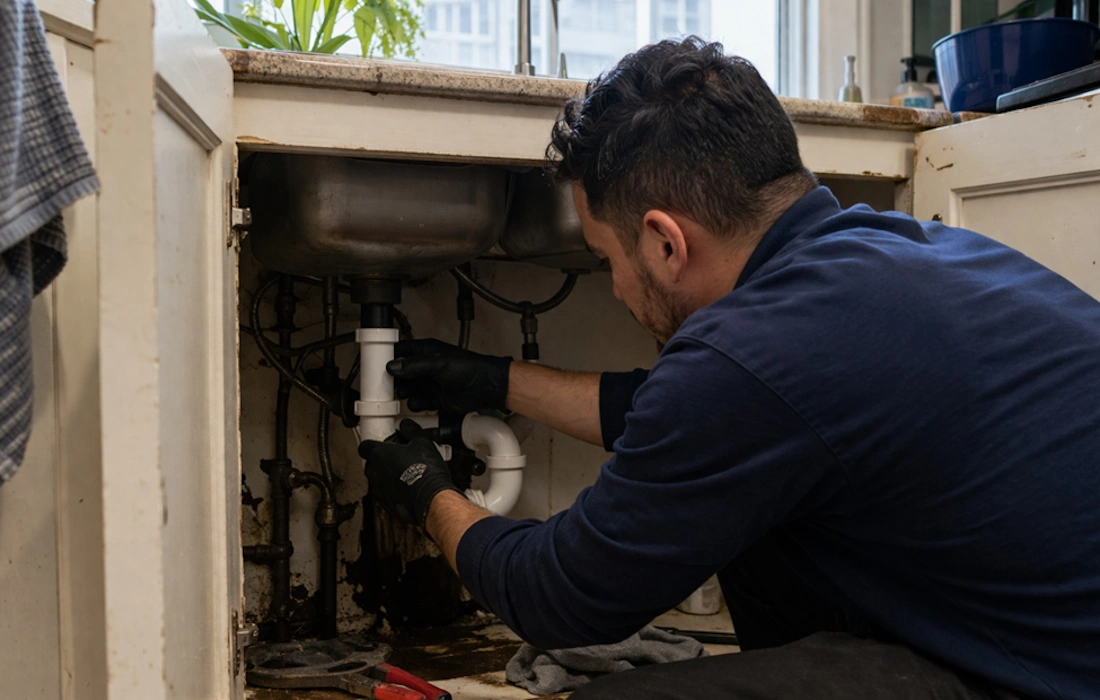
Support the bathroom fixture section with actual installation proof
Commercial & Multifamily Fixtures
Restrooms, hand sinks, sensor faucets, accessibility, and occupied-property service
Commercial fixture service is not just residential plumbing with a larger invoice. The service call may affect employees, customers, tenants, food preparation, sanitation, public restrooms, accessibility,operating hours, and the ability to close a water line. Offices, restaurants, retail spaces, professional buildings, multifamily properties, medical or service spaces, and managed facilities need clear communication about which fixture is affected, who can approve work, where shutoffs are located, and whether the repair can occur during occupied hours.
Common commercial work can include leaking public lavatory faucets, sensor faucets that will not activate, metering faucets that shut off too quickly, loose wall-hung sinks, clogged aerators, failed flush valves, hand sinks, prep sinks, service sinks, utility faucets, supply stops, trap leaks, restroom upgrades, and fixture replacement during tenant improvements. Commercial brands and parts may differ from residential fixtures, and model information can determine whether a repair is practical or replacement is the faster path.
Accessibility must be treated as a real design requirement, not a sticker on a product box. U.S. Access Board guidance explains that manually operated faucet controls in accessible applications must be usable with one hand without tight grasping, pinching, or twisting, and manual metering faucets must remain open for at least ten seconds. Motion-activated controls have different timing rules. Property owners and designers can review the official lavatory and sink accessibility guide. Final compliance depends on the complete room, fixture, clearances, mounting, controls, piping protection, and applicable project requirements.
Pressure & Water Quality
Aerators, scale, filtration, softening, corrosion, and whole-house symptoms
Mineral buildup, sediment, staining, odor, taste, and corrosive water conditions can damage aerators, cartridges, valves, finishes, sprayers, appliances, and water-heater components. Cleaning or replacing one aerator may restore flow temporarily while the underlying condition continues throughout the
property. The plumber should compare multiple fixtures, inspect both hot and cold sides, and ask whether the home already uses filtration, softening, or point-of-use treatment.
An under-sink filter, reverse-osmosis system, or instant-hot unit changes the available cabinet space and adds tubing, valves, tanks, drains, and specialized faucets. New kitchen fixtures must be planned around those components. If water quality is the main concern, use Manzo’s water treatment systems, water filtration, and water softener installation pages rather than turning the faucet replacement into an unsupported promise about what the water will taste like afterward.
Pressure should also be evaluated at the correct level. Low flow at one faucet may be local. Low pressure across the house can involve a main valve, pressure-reducing valve, water service, corrosion, filtration restriction, municipal conditions, or undersized piping. Excessive pressure can accelerate wear on cartridges, supply lines, valves, appliances, and fixtures. The Department of Energy’s federal facility guidance recommends testing pressure and addressing leaks promptly; customers can review its faucet and showerhead water-management guidance.
Water that appears discolored, cloudy, or rusty at one faucet may be related to the aerator or local fixture. Similar symptoms at multiple fixtures require broader investigation. The correct repair should follow the pattern of the problem, not whichever component is easiest to reach. Plumbing is unreasonably committed to cause and effect, despite generations of humans hoping a shiny new faucet can solve everything upstream.
Emergency & Water-Damage Decisions
When to shut off water, call now, protect the property, and document damage
A slow drip into the sink can usually be scheduled. Water spraying from a supply line, flowing through a cabinet, entering the floor, appearing in the ceiling below, or leaking near electrical equipment needs faster action. Close the fixture shutoffs when they work safely. Use the main water shutoff when thelocal valves do not stop the leak and the damage is active. Move stored items out of the cabinet, protect nearby finishes, and avoid electrical hazards. Then call Manzo emergency plumbing and describe whether the water is still moving.
Do not force an old shutoff valve that is badly corroded, seized, or leaking from the stem. The attempt to stop a small fixture leak can break the valve or connected pipe and create a larger one. Do not keep running the faucet to “find the leak” when water is already spreading. Do not pour drain cleaner into a sink that a plumber may need to disassemble. Do not place a bucket under a leak and declare a permanent peace treaty with it. Buckets are excellent temporary diplomats and terrible repairs.
Cabinet damage should be documented after the water is controlled. Photograph wet areas, remove saturated materials when it is safe and appropriate, and contact the relevant restoration or insurance resources when damage extends beyond the plumbing repair. The plumber fixes the source and can document the condition found. Drying, cabinet replacement, flooring, mold remediation, and finish reconstruction may involve other qualified trades.
Repeated moisture without an obvious active leak can come from condensation, drain leakage, a hidden supply leak, a dishwasher connection, a disposal, water traveling from the countertop, or piping behind the wall. The service visit should reproduce the conditions rather than assuming the first wet fitting is responsible for every stain in the cabinet.
Repair or Replace?
Make the decision from condition, compatibility, parts, labor, and future plans
Repair is often the better value when the failure is isolated and the fixture remains structurally sound. Replacement becomes more attractive when parts are unavailable, corrosion is advanced, failures repeat, the layout no longer works, or a remodel already requires the fixture to be removed. The decision should include the connected shutoffs, supplies, drain parts, countertop, sink, cabinet, disposal, filtration, and warranty implications.
| Condition | Practical direction |
|---|---|
| Young, serviceable faucet with an available cartridge | Repair is often reasonable when the body, finish, mounting, supplies, and shutoffs remain in good condition. |
| Repeated leaks from several components | Replacement may reduce repeat labor when the fixture is worn, proprietary parts are costly, or multiple assemblies are failing. |
| Corroded body, cracked casting, failed finish, or loose internal structure | Replacement is usually more reliable than attempting to rebuild a deteriorated fixture body. |
| Sink leak limited to trap, strainer, supply, or drain assembly | Repair the failed component when the sink and mounting remain sound. |
| Cracked, rusted, unsupported, or separating sink | Replacement and structural support may be required, sometimes with cabinet or countertop coordination. |
| Remodel or countertop replacement | Plan sink, faucet, accessories, drains, disposals, filtration, and hole locations together before fabrication. |
| Commercial fixture with obsolete proprietary parts | Compare part availability, lead time, labor, downtime, code or accessibility needs, and replacement compatibility. |
| Low pressure at several fixtures | Investigate the broader water system before replacing several faucets that are all reporting the same upstream problem. |
Faucet & Sink Cost Factors
Price depends on the fixture, access, connected plumbing, and installation scope
The useful cost answer is not a fake universal faucet number. Cost depends on whether the job is a focused cartridge repair, a standard replacement, a wall-mounted rough-in, a sink and countertop change, an under-sink leak with damaged valves, or a commercial fixture that must be repaired around occupied hours. A clear price follows inspection of the fixture and the connected work.
Customers comparing estimates should ask whether the price includes removal, new supplies, new shutoffs, drain parts, disposal reconnection, filtration reconnection, mounting support, testing, cleanup, and disposal of the old fixture. The lowest number may exclude predictable work that appears after the sink is already apart. Manzo’s financing options and current offers can be reviewed when the project is larger than a routine repair.
Fixture design
Standard residential faucets, touchless controls, wall-mounted fixtures, commercial metering faucets, specialty imports, filtered-water faucets, and integrated systems require different parts and labor.
Parts availability
Manufacturer, model, age, finish, proprietary cartridges, sensors, solenoids, valves, hoses, and special adapters affect whether repair can be completed immediately.
Access below the sink
Deep bowls, disposals, filtration tanks, crowded cabinets, corroded mounting nuts, drawers, shelves, and finished panels can increase removal and installation time.
Shutoffs and supplies
Old valves, leaking stems, rigid supplies, corroded fittings, damaged escutcheons, and inaccessible branch piping can add required work beyond the fixture.
Sink and countertop work
Undermount support, farmhouse cabinets, stone cutouts, wall mounting, pedestal alignment, drain relocation, and countertop fabrication can turn a simple replacement into a coordinated project.
Drain and disposal connections
Basket strainers, pop-ups, traps, disposals, dishwasher hoses, air gaps, venting, and existing drain height affect the final installation.
Commercial scheduling
Occupied hours, tenant access, restroom closures, public safety, approvals, parts lead time, and after-hours work can influence service planning.
Broader plumbing conditions
Low pressure, hidden leaks, corroded piping, water quality, repeated clogs, water-heater issues, or water-line problems may require diagnosis beyond the visible fixture.
Customer-supplied products
Missing parts, damaged products, wrong hole patterns, incompatible drains, unknown warranties, and return delays can affect the project sequence.
Major Brands
Faucet, sink, fixture, and commercial brands serviced
Manzo services and installs many major faucet, sink, fixture, and commercial plumbing brands. The list is representative. Exact serviceability depends on the model, age, part availability, installation, warranty, and whether the manufacturer still supports the component. Some proprietary electronic or imported fixtures may require special-order parts or replacement.
Brand names help the customer provide useful information, but they should not become a 30-name keyword avalanche in every section. Take clear photos of the fixture, logo, handle, spray head, underside connections, and any label or model number. That preparation is more useful than guessing that every chrome faucet is secretly a Moen.
Residential faucet brands
BrassKingston BrassKallista
Kitchen and sink brands
Commercial and institutional brands
CommercialAmerican Standard CommercialElkay Commercial
What to Expect
A service process that reduces missing parts, wrong fixtures, and surprise scope
A well-organized fixture call starts before dispatch. The office should collect the address, room, fixture type, brand or model if known, symptoms, whether the leak is active, whether shutoffs work, and whether the customer already purchased a replacement. Photos of the top, underside, cabinet, valves, drain, and product box can reduce surprises.
On site, the plumber confirms the source and tests the connected system. That may include hot and cold flow, faucet operation, sprayer, sensor or control box, supply lines, shutoffs, mounting, sink seal, drain, trap, disposal, dishwasher connection, water pressure, and the condition of nearby materials. The diagnosis separates the immediate failure from optional improvements and broader plumbing concerns.
After approval, the technician completes the repair or installation, restores the water, operates the fixture repeatedly, checks hot and cold flow, fills and drains the basin, inspects every disturbed connection, verifies the disposal or accessories when applicable, and cleans the work area. The customer should understand what was replaced, what remains, and any product warranty or maintenance requirement.
instinct.
5–10 Mile Core Service Grid
Wantagh-centered faucet, sink, and fixture service across Nassau County
For everyday faucet and sink work, routing matters because the ticket can be smaller than a major sewer, water-line, repiping, or commercial project. The primary service emphasis should stay near Manzo’s Wantagh base and the dense Nassau County communities within a practical five-to-ten-mile
operating area. That includes Wantagh, Seaford, Bellmore, Merrick, Massapequa, Massapequa Park, Levittown, East Meadow, Bethpage, Farmingdale, Plainview, Hicksville, and nearby neighborhoods. Babylon and other western Suffolk locations can be served when scheduling and the project scope make sense.
Why Choose Manzo
Long Island plumbing experience, direct service paths, and verified proof
Related services
drainsKitchen & Bath Rough-InsRemodeling and relocated fixture pipingWantagh Toilet ServiceRelated local toilet repair and installationWantagh Commercial PlumbingExisting local commercial supportService AreaLong Island coverage and nearby communitiesReviewsVerified customer proofFinancingPayment options for larger projectsCouponsCurrent offers without hard-coding expiration datesResourcesHelpful Manzo service guidesContactRequest plumbing service
EPA WaterSense Bathroom Faucets
Official efficiency and product-label guidance for qualifying private bathroom sink and bar-sink faucets.
U.S. Access Board Lavatories & Sinks
Official accessibility guidance covering controls, operation, clearance, metering, and related fixture requirements.
DOE Faucet Water Management
Federal best practices covering prompt leak repair, pressure, maintenance, and water-efficient operation.
Long Island Faucet & Sink FAQs
Questions customers ask before repair, replacement, or installation
Do you repair and replace faucets throughout Nassau County and nearby Long Island?
Yes. Sal Manzo Plumbing, Heating & Cooling provides faucet, sink, and fixture repair,
replacement, and installation across Nassau County and nearby western Suffolk communities. The
primary service focus includes Wantagh, Seaford, Bellmore, Merrick, Massapequa, Massapequa Park,
Levittown, East Meadow, Bethpage, Farmingdale, Plainview, Hicksville, and nearby areas.
Why does my faucet keep dripping after it is turned off?
A continuing drip can result from a worn cartridge, washer, ceramic disc, valve seat, O-ring,
stem, seal, or damaged faucet body. The correct repair depends on the faucet design, brand,
model, condition, and whether corrosion or discontinued parts make replacement more practical.
Can you repair a faucet that leaks only when it is running?
Yes. Water that appears only during use can come from the faucet body, handle, base, sprayer
hose, pull-down connection, supply line, mounting area, or water traveling along the underside
of the fixture. The technician should operate the fixture and inspect the cabinet while the leak
is active.
Should I repair an old faucet or replace it?
Repair often makes sense when the fixture body, finish, mounting, shutoffs, and supplies remain
sound and the failed part is available. Replacement may be the better value when corrosion is
advanced, parts are obsolete, failures repeat, the fixture is loose or damaged, or the customer
wants a different function or layout.
Can Manzo install a faucet or sink that I purchased?
Customer-supplied fixtures can often be installed when they fit the sink, counter, cabinet,
plumbing, and application and include all required components. Keep the model information,
receipt, packaging, drain parts, adapters, and warranty documents. Incompatible products or
missing proprietary parts can delay the job.
Why is there low pressure at only one faucet?
Low flow at one fixture may involve a clogged aerator, mineral buildup, partially closed shutoff,
damaged supply line, failed cartridge, debris, or a restriction inside the faucet. Low pressure
at several fixtures may point toward water-line, valve, filtration, softener, pressure, or
piping problems.
Why does my sink leak only when it drains?
A drain-only leak can come from the basket strainer, pop-up assembly, tailpiece, disposal flange,
dishwasher connection, trap, slip joint, cracked drain component, or overflow path. Filling the
basin and releasing the water helps reproduce the condition and identify the source.
Do you repair touchless and sensor faucets?
Service may include batteries, power supplies, sensors, solenoids, control boxes, connections,
flow problems, and fixture-specific components. Model information is especially important
because proprietary electronic parts may need to be ordered, and replacement can be more
practical when support is limited.
Do you install kitchen sinks and farmhouse sinks?
Yes. Installation planning may include drop-in, undermount, farmhouse, workstation, stainless,
cast-iron, composite, and other kitchen sinks. Cabinet support, countertop fabrication, drain
location, disposal clearance, accessories, and plumbing connections must be coordinated before
installation.
Do you work on commercial sinks and public restroom faucets?
Yes, within Manzo’s confirmed light-commercial scope. Service may include offices, retail,
restaurants, multifamily properties, professional spaces, public lavatories, hand sinks, service
sinks, sensor faucets, metering controls, supply stops, drains, and fixture replacement. Share
access, operating hours, approval, and occupancy details when scheduling.
Are WaterSense labels available for every faucet?
No. EPA WaterSense criteria currently apply to qualifying private bathroom sink and bar-sink
faucets and accessories. Ordinary kitchen faucets, public lavatory faucets, and several other
product categories are not eligible for the WaterSense label, although customers can still
compare efficiency and performance.
Can a dripping faucet waste a meaningful amount of water?
Yes. The amount depends on the drip rate, but persistent leaks add up and can also signal worn
components that may worsen. Prompt repair reduces water waste and protects the fixture, valves,
cabinet, and connected plumbing from additional damage.
What should I do if a supply line is spraying under the sink?
Shut off the fixture valves when they work safely. Use the main water shutoff when necessary to
stop active damage. Avoid electrical hazards, move stored items, and call emergency plumbing. Do
not force a badly corroded valve or continue operating the fixture to test the leak.
Can hard water or sediment damage faucets?
Mineral buildup and sediment can restrict aerators, damage cartridges and valves, affect
sprayers, stain fixtures, and shorten the service life of some components. When several fixtures
show scale, staining, odor, taste, or restricted flow, water filtration or softening may deserve
evaluation.
What information should I send before scheduling fixture service?
Provide the address, room, fixture type, brand or model if known, symptoms, whether water is
actively leaking, whether shutoffs work, and whether you purchased a replacement. Clear photos
of the top, underside, valves, supplies, drain, cabinet, and product label help the office
prepare.
Faucet, Sink & Fixture Service
Fix the leak, replace the fixture, and protect the plumbing around it
Call Sal Manzo Plumbing, Heating & Cooling for faucet, sink, fixture, shutoff, supply, drain, commercial, and installation service across Nassau County and nearby Long Island communities.