
Good AC Installation Starts Before the Equipment Is Ordered
Long Island homeowners usually start the conversation with a simple question: “What size air conditioner do I need?” The useful answer takes more work. Cooling capacity has to match the home, but capacity is only one part of comfort. The indoor coil, outdoor condenser, blower, duct system, refrigerant piping, thermostat, electrical supply and condensate drainage all have to work together.
That is why a new air conditioning installation should begin with an evaluation of the existing house. A Cape in Levittown with finished upstairs rooms, a split-level in Merrick, a ranch in Wantagh and a larger two-story home in Massapequa can have very different cooling loads even when the square footage looks similar on paper. Window area, insulation, ceiling height, sun exposure, air leakage, duct location and how the rooms are used can change the result.
Cooling-load planning
Estimate the actual sensible and latent cooling needs of the home instead of automatically matching the old unit’s tonnage.
Matched equipment
Choose compatible indoor and outdoor components so rated efficiency and capacity are based on a tested system combination.
Airflow
Review blower performance, return-air capacity, supply runs, registers and room-to-room balance so conditioned air can reach the spaces that need it.
Ductwork
Inspect existing ducts for sizing, leakage, insulation, restrictions and layout problems that can undermine a brand-new system.
Controls & electrical
Confirm thermostat compatibility, disconnects, breakers, wiring and any electrical work required for the selected equipment.
Drainage & commissioning
Plan condensate removal, then test airflow, refrigerant charge, temperature split, controls and operation after installation.
Why Manual J-Style Load Calculations Matter on Long Island
Bigger is not automatically better. An oversized air conditioner may satisfy the thermostat quickly and shut off before it has run long enough to remove as much indoor moisture as the home needs. That can leave rooms cool but clammy, increase cycling and make comfort less consistent. Undersizing creates the opposite problem: long run times and difficulty maintaining temperature on the hottest afternoons.
ENERGY STAR advises homeowners to have contractors verify system size with a Manual J calculation or equivalent load calculation. The calculation considers more than floor area. It looks at insulation, windows, orientation, infiltration, design temperatures and other characteristics that influence the home’s heating and cooling load.
For a Long Island AC installation, this is especially useful when the house has changed since the previous system was installed. New windows, an attic conversion, an addition, air sealing, insulation work or a finished basement can all change the load. Replacing a 20-year-old three-ton condenser with another three-ton condenser just because the nameplate says “3 ton” skips the most important question: what does the house need now?
- Conditioned square footage and ceiling height
- Window size, orientation and solar exposure
- Insulation and air leakage
- Number of floors and room layout
- Attic, basement and crawl-space conditions
- Existing duct location and insulation
- Internal heat and typical occupancy
- Recent additions or envelope upgrades
The goal is not to turn a homeowner into an HVAC engineer. It is to avoid guessing when selecting one of the most expensive mechanical systems in the house.
Get the house evaluated before you choose the equipment.
Your Ductwork Can Make or Break a New Central Air Installation
Central air depends on moving the right amount of air through the home. A high-efficiency condenser cannot fix undersized returns, crushed flex duct, poorly insulated attic runs, leaky joints or bedrooms that never received enough supply air in the first place. If the old system always left the second floor hot or one side of the house uncomfortable, installation day is the wrong time to pretend the ductwork has nothing to do with it.
Existing ductwork may be reusable when it is…
- Properly sized for the planned airflow
- In good physical condition
- Reasonably sealed at trunks and branches
- Insulated where it passes through hot or unconditioned spaces
- Laid out to serve the rooms the way the family actually uses them
- Supported and accessible enough for repairs or adjustments
Duct upgrades may be worth discussing when…
- The old system was noisy or starved for return air
- Upstairs rooms stay warmer than the thermostat area
- Airflow is weak at distant registers
- Sections of duct are damaged, disconnected or uninsulated
- The home has been expanded or remodeled
- The new equipment requires airflow the existing layout cannot reliably deliver
What Homeowners Should Expect After a Clean AC Installation
The best installation is not the one with the largest piece of equipment or the longest feature list. It is the one that quietly keeps the house comfortable, drains correctly, starts and stops normally, delivers balanced airflow and gives the homeowner understandable controls.
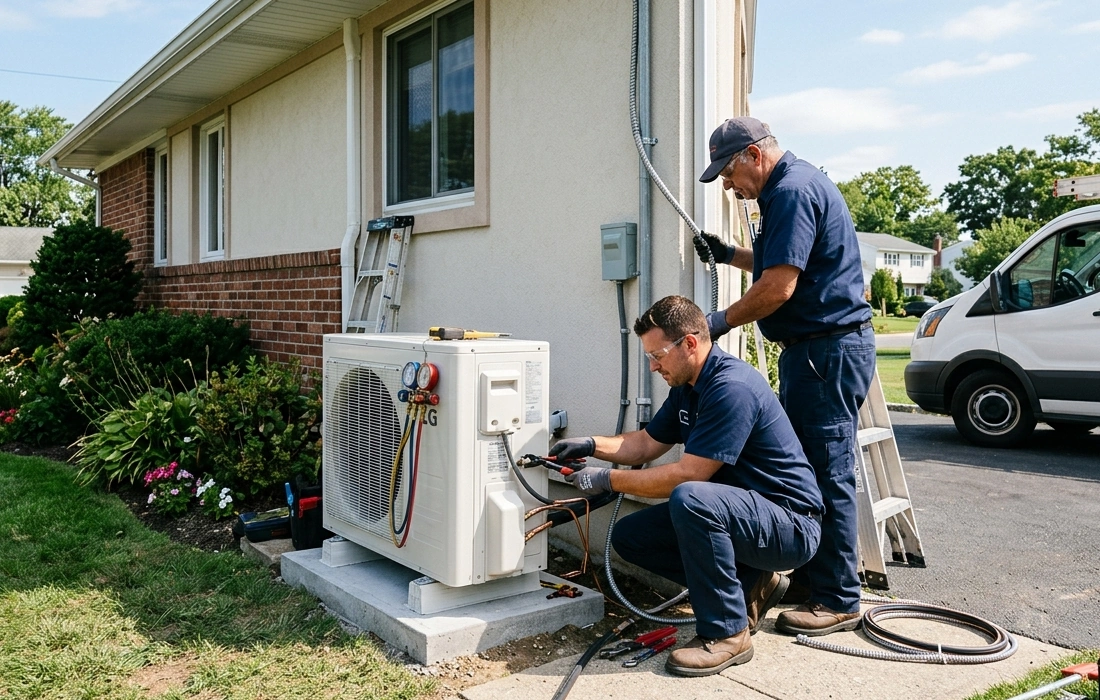
After installation, the system should be started, tested and reviewed. That includes confirming thermostat operation, checking air movement, verifying that condensate drains as intended, making sure the outdoor unit has appropriate clearance, and reviewing filter access and basic maintenance. The homeowner should also understand what was installed and whom to call if something does not feel right.
For homeowners replacing a failed system, the goal is not merely to restore cold air. It is to correct the weaknesses that made the old setup uncomfortable or expensive whenever practical.
Efficiency Matters, but Installation Still Determines How the System Performs
New residential air conditioners are rated using SEER2, the current seasonal efficiency metric. Long Island is in the northern federal region, where the current baseline for typical split-system central air conditioners is 13.4 SEER2. Higher-efficiency equipment is available, but the right target depends on budget, run time, comfort goals, matched components and how long you expect to remain in the home.
Efficiency ratings are useful for comparing equipment under standardized test conditions. They do not erase the basics. Poor airflow, duct leakage, bad equipment matching or incorrect refrigerant charge can keep a high-rated system from delivering the comfort and operating performance a homeowner expected.
Single-stage
Traditional on/off operation. Often the simplest equipment choice and may fit homes where straightforward cooling and lower upfront complexity are priorities.
Two-stage
Can operate at a lower stage during moderate conditions and a higher stage when the cooling load increases, which may improve comfort and run-time behavior.
Variable-capacity
Modulates over a wider operating range. It can provide longer, lower-output cycles and tighter comfort control when the duct system and controls are designed to support it.
What changed with newer refrigerants?
Federal HFC rules have changed the refrigerants used in much of the new residential air-conditioning and heat-pump equipment market. EPA’s current rules limit many newly manufactured or installed residential and light-commercial systems to refrigerants with a global-warming-potential threshold of 700, while preserving specific provisions for qualifying pre-2025 components. In practical homeowner terms, a 2026 proposal may involve equipment and refrigerants that differ from the R-410A systems that dominated the previous generation.
This is not a reason to panic or replace a working system. It is a reason to make sure the indoor and outdoor components are properly matched, the installer follows the equipment manufacturer’s requirements and the homeowner knows what refrigerant family the new system uses. Refrigerant rules have also been revised recently, so current equipment availability and requirements should be verified at the time of the job rather than copied from an old blog post.
Four Steps From “Our House Is Too Hot” to a Properly Commissioned System
Every project is different, but a disciplined installation process keeps the important decisions in the right order. The equipment should follow the evaluation, not lead it.
Evaluate the home
Review the existing HVAC setup, comfort complaints, equipment age, ductwork, electrical requirements, condensate route and the spaces that are hardest to cool.
Design the solution
Determine cooling-load needs, identify equipment options, confirm whether ducts can be reused, and explain whether central AC, a heat pump or ductless approach best fits the project.
Install cleanly
Set equipment, connect matched components, complete refrigerant and condensate work, protect the home and handle the details required for a professional installation.
Start, test & explain
Commission the system, verify operation, review controls, explain filter and maintenance basics and make sure the homeowner understands the finished installation.
Central Air, Heat Pump or Ductless? Installation Planning Should Compare the Right Options
“Air conditioning installation” does not always mean one standard condenser paired with one standard air handler. Long Island homes vary too much for that. A home with usable ducts may be an excellent central-air candidate. A homeowner already replacing both heating and cooling equipment may want to compare a ducted heat pump. A home without ducts, or an addition that never cools well, may be better served by a ductless system.
Central air conditioning
A strong fit for homes with suitable ductwork or projects where installing ducts is practical. Central AC uses an outdoor condenser and an indoor coil/air-handling system to distribute cooling through supply and return ducts.
Ducted heat pump
Provides central cooling and can also provide heating. It deserves consideration when a homeowner is planning a larger HVAC replacement and wants one electric system to handle more of the year.
Ductless mini split
Useful where ductwork is absent or impractical, including additions, finished attics, garages converted to living space, home offices and rooms with chronic comfort problems.
Small-duct / specialty designs
Some older Long Island houses have limited space for conventional ductwork. Specialty systems can sometimes solve architectural constraints, but design details and available installation paths should be evaluated before promising a specific approach.
Important: If the existing AC is broken and you are deciding whether it can be fixed, use Manzo’s Air Conditioning Repair Long Island resource. This is deliberately focused on planning and installing a new system.
Is This a First-Time Central AC Installation or a Replacement?
The scope can change dramatically depending on what the house already has. Replacing an existing central-air system may allow portions of the duct network, electrical setup, line-set route and equipment locations to remain, provided they are appropriate for the new system. Installing central air in a house that never had ducts can involve a much larger design and construction project.
That difference is why installation estimates should be based on the actual site. A clean changeout with usable ducts is not the same project as running new supply and return ducts through an older two-story house. Likewise, replacing only the outdoor condenser without reviewing the indoor coil and system match can create performance and compatibility problems.
Older Homes, Finished Attics and Hot Second Floors Need More Than a Tonnage Guess
Across Nassau County, many houses were built long before today’s central-air equipment and comfort expectations. Cape-style homes may have finished upper floors tucked beneath hot rooflines. Split-levels can have complicated return-air paths. Ranches may have attic ductwork exposed to extreme summer temperatures. Additions are sometimes connected to a system that was never designed to serve the extra load.
These are design problems first. A larger air conditioner may not solve a poorly served room. Sometimes the answer is a duct correction, return-air improvement, zoning strategy, insulation or air-sealing conversation, or a separate ductless zone for a difficult space. The important thing is recognizing the problem before installing new equipment and expecting the equipment to perform a magic trick.
Homeowners in Wantagh, Seaford, Bellmore, Merrick, Levittown and Massapequa often have very different house layouts within a relatively small geographic area. Local experience matters because the installer has likely seen the same kinds of attic runs, additions, low-clearance spaces and room-balance complaints before.

$1,000 Off Qualifying HVAC Installation or Replacement
Manzo’s offer includes qualifying central-air and HVAC installation or replacement projects. The customer must mention the offer when booking; it cannot be combined with other offers and is currently listed to expire December 31, 2026.
Air Conditioning Installation Across Long Island
Sal Manzo Plumbing, Heating & Cooling serves homeowners across Nassau County and selected nearby Suffolk County communities. Availability can vary by project type and distance, so call the office to confirm scheduling for your address.
One Local Team for the Cooling System Around the Equipment
Air conditioning installation intersects with more than the condenser. There may be condensate drainage, water protection, electrical coordination, ductwork, heating equipment, thermostats and existing mechanical systems in the same space. Manzo’s broader plumbing, heating and cooling background helps keep the project focused on the whole mechanical setup rather than one isolated component.
Sal Manzo Plumbing, Heating & Cooling has served Long Island since 1986. 1461 Google reviews, and licensed and insured technicians, same-day scheduling when available and service across Nassau and Suffolk County.
Questions Long Island Homeowners Ask Before Installing Central Air
How do I know what size central air conditioner my Long Island home needs?
System size should be based on the home’s actual cooling load rather than square footage alone. A Manual J-style load calculation considers factors such as insulation, windows, orientation, air leakage, ceiling height and local design conditions. Existing duct capacity also matters because the system has to move the required airflow through the house.
Can you install central air in a Long Island home that has never had ductwork?
Often, yes, but the feasibility and scope depend on the layout of the house and available routes for supply and return ducts. Some homes are straightforward; others have finished attics, limited chases or architectural constraints that make conventional ductwork more invasive. Ductless or specialty systems may be worth comparing when full ductwork is impractical.
Should I replace my ductwork when I install a new AC system?
Not automatically. Existing ducts may be reusable if they are correctly sized, reasonably sealed, insulated where needed and in good condition. Duct modifications may make sense when airflow has always been weak, returns are undersized, ducts are damaged or the home has changed since the original system was designed.
What is SEER2?
SEER2 is the current seasonal efficiency rating used for residential central air conditioners and heat pumps. Higher numbers represent greater rated seasonal efficiency under standardized testing. Long Island falls in the federal northern region, where typical split-system central AC equipment has a 13.4 SEER2 baseline standard. The best choice depends on equipment cost, expected use, comfort goals and the quality of the installation.
Do I need the highest SEER2 rating available?
No. The highest rating is not automatically the best value for every house. Compare upfront cost, staging, controls, expected run time, warranty terms, how long you expect to stay in the home and whether the duct system can support the equipment. A correctly installed, properly sized system is more important than chasing a rating while ignoring airflow and design.
What refrigerant do new air conditioners use in 2026?
The residential market is transitioning toward lower-GWP refrigerants under federal HFC rules, so many new systems use refrigerants different from the R-410A equipment common in the previous generation. Exact refrigerant depends on the manufacturer and model. Because federal rules were revised in 2026, confirm the current equipment, refrigerant and installation requirements at the time of purchase.
Should I install central AC or a heat pump?
Central AC provides cooling only, while a ducted heat pump can provide both cooling and heating. If you are replacing more than one major HVAC component, a heat pump deserves comparison. If your heating system is newer and working well, a central AC-only installation may remain a practical choice. The right answer depends on the home, fuel setup, electrical capacity, comfort goals and economics.
Is ductless better than central air?
Neither is universally better. Central air can provide whole-home cooling through ducts with discreet registers. Ductless systems avoid major duct installation and can be excellent for additions, finished attics or homes without ducts. Some homes use both, with central air serving most rooms and a ductless zone solving one stubborn comfort area.
How long does central air installation take?
Project length depends heavily on scope. A replacement using suitable existing ducts and equipment locations is very different from a first-time central AC installation that requires new ducts, electrical work and new routes through the house. The contractor should explain the expected schedule after evaluating the home rather than promising a universal one-day answer.
What should be tested after AC installation?
The completed system should be started and commissioned. Important checks can include thermostat operation, airflow, refrigerant setup, condensate drainage, equipment response and overall cooling performance. The homeowner should also be shown filter access, controls and basic maintenance expectations.
Does Manzo offer an installation discount?
As of August 17, 2026, Manzo’s website lists $1,000 off qualifying new boiler or HVAC installation/replacement, including central air. The offer says it must be mentioned when booking, cannot be combined with other offers and expires December 31, 2026. Check the current coupons page before scheduling because offers can change.
Where does Sal Manzo provide AC installation service?
Manzo serves Long Island homeowners across Nassau County and selected nearby Suffolk County communities. Core areas include Wantagh, Seaford, Bellmore, Merrick, Massapequa, Levittown, East Meadow, Bethpage, Plainview, Farmingdale and nearby towns. Call 516-783-0490 to confirm scheduling and service availability for your address.
Install the system around the home, not the other way around.
Call Sal Manzo Plumbing, Heating & Cooling to discuss air conditioning installation in Wantagh, Nassau County and nearby Long Island communities.